


 Cash
Cash



A direct ride to BER is not necessarily the best option for every trip. This article looks at “Private BER Transfer with Dogs and Cats” plainly and explains when a private transfer can make sense.
Structure departure and return travel
The information on this page does not replace the booking-form details. The options and conditions shown there apply to the specific journey.
The dog wants to come to Mallorca. Or the cat has to move to a new home. And then you face the question: will the taxi driver even take the animal? The short truth: he doesn't have to. But he can, if you go about it the right way - with a pre-booked airport transfer to BER, bringing a pet along is clearly regulated anyway.
Pets and taxis is a topic many owners feel unsure about. Yet the rules are fairly clear once you've understood them.
Can a taxi driver refuse the dog?
Legally: yes. Under the Passenger Transport Act there is no general obligation to carry animals. The driver may refuse transport if the animal could soil the vehicle, if it behaves aggressively, if other passengers want no contact with it, or if he himself has a demonstrable allergic reaction.
In practice this means: anyone waiting at the kerb at five in the morning with a Labrador and flagging down the first taxi sometimes gets unpleasant surprises. The first one drives on. The second sees the dog and says "no, no fur in the car". The third takes you, but only if the animal rides right at the back in the boot.
One important exception: assistance and guide dogs. They must be carried, full stop. This is governed by the Federal Disability Equality Act. A taxi driver who refuses a guide dog risks a fine - and serious trouble.
Why book in advance with the pet option
Because it saves you the stress at the kerb. When you book in advance, you state that an animal is coming along. The operator finds a driver who accepts it. Done. No argument at five in the morning, no hoping for luck.
Especially for early flights, where every minute counts, this is worth its weight in gold. The driver knows what to expect, arrives with a suitable vehicle, and the trip runs without drama.
Which animals can come along?
Basically all pets that can be transported safely. Dogs are the most straightforward - small ones in a carrier, medium and large ones on a lead with a safety harness. Cats always in the carrier; let one out and you'll never get it back out of the footwell again.
Rabbits, guinea pigs, ferrets: in the carrier. Birds in covered cages - the cover calms them. Reptiles in suitable transport containers with a stable temperature.
Unusual animals such as parrots or even snakes should be mentioned separately when booking. Not every driver is prepared for that, and some refuse out of sheer uncertainty. With advance notice it usually works.
Carrier - yes or no?
For small dogs up to about ten kilos: yes, a carrier. Cats, always: yes, a carrier. This isn't harassment, it's safety. In an emergency stop an unsecured animal flies through the cabin with full force - dangerous for both animal and people.
Medium and large dogs are a different case. Forcing a Labrador or German Shepherd into a carrier is impractical and often more stressful for the animal than being on a loose lead. Here a safety-harness belt that clicks into the car's seatbelt works well, or a safety grille in the boot of an estate car.
The legal basis is Section 22 of the road traffic regulations on securing loads. An unsecured animal counts as an unsecured load - in an accident the owner is liable.
What does it cost to bring a pet?
On pre-booked fixed-price trips to BER, the pet option is usually free. You activate it when booking, the vehicle arrives suitably prepared, and the price doesn't change.
With classic metered taxis it varies wildly. Some charge a cleaning flat fee of three to five euros, others nothing, and still others demand a full ten euros "for the extra effort". Anyone who wants predictability takes the fixed-price route.
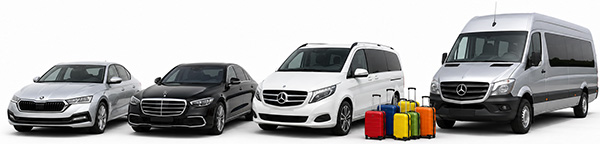
Typical fixed prices from central Berlin to BER: Economy 67 euros, Comfort 68 euros, Minivan 138 euros, Minibus 7pax 88 euros. For larger dogs the Minivan or Minibus is often more comfortable, thanks to more space.
Getting ready before the trip
Open the carrier days in advance, put a treat inside, and let the animal go in voluntarily. Pulling out an unfamiliar carrier just before the trip and heaving the dog in is stressful for everyone.
Take a quick walk before departure. A well-exercised dog travels more calmly. With cats that's not possible, but a familiar cloth in the carrier that smells of home helps against the unease.
Don't feed right before the trip. Light snacks are okay, but a full bowl can cause nausea in excited animals. Water to offer on longer trips is fine, though.
A quick brush. It reduces the amount of hair left behind in the taxi, and is a courtesy to the driver and the next guests.
When the animal flies along too
Travelling abroad with an animal means: EU pet passport, microchip number entered in it, valid rabies vaccination. The airline needs advance notice, and some require IATA-compliant transport carriers built to strict specifications.
For non-EU destinations like the UK, USA or Asian countries, additional health certificates apply, sometimes quarantine rules. This has to be sorted four to six weeks before the trip, not three days beforehand at the vet's.
Worth an honest thought: does the animal really need to come? A ten-hour flight in the cargo carrier is considerable stress for many animals. For a short holiday a pet sitter or boarding facility is often the better solution. For a move or long-term travel it's of course a different picture.
Four scenarios from practice
Couple with a terrier in a carrier. Economy is enough. The carrier between the two of you on the back seat, no problem.
Family with a Golden Retriever and a pram. Minivan, or better a Minibus. The dog on a harness in the footwell or in the boot, buggy and suitcases in the load space. In Economy it gets cramped.
A move with two cats and three boxes. Minibus 7pax. Room for two carriers side by side, enough storage for moving goods.
Business trip with an assistance dog. Book it like a normal trip, activate the pet option, briefly note that it's an assistance dog. The driver will accept it without a problem.
Several animals at once? That works, just state it when booking. With several dogs or a dog-and-cat combination, the Minivan or Minibus is more comfortable - more distance between the animals.
What if my dog soils something in the taxi? Normal fur residue is factored into the fixed price. For heavy soiling (vomit, larger puddles) a cleaning flat fee may apply; this is set out in the terms and conditions - usually between 30 and 50 euros.
Are there specialised dog taxis? In Berlin, yes, they exist. For normal airport transfers with an animal, though, the regular service with the pet option is enough. Specialised providers are more worthwhile for vet transports or for animals that need special care.
My dog is afraid of cars. Give the vet a quick call. There are gentle herbal calming remedies, and in extreme cases prescription alternatives too. Some animals travel much more calmly after their first good experience - a positive example: a short test drive with a favourite reward afterwards.
Is the dog allowed on the back seat? Small ones in the carrier, always. Medium and large ones on a lead with a harness clipped to the seatbelt. Not simply loose on the back seat - otherwise it flies forward when braking.
Book an airport taxi with a pet online
Address, time, people, suitcases. Under the additional options choose "pet" and briefly note the type and size. The driver then knows what to expect, the vehicle arrives suitably prepared, and you set off with no surprises.
More on the topic: Large-capacity taxi for bigger animals, Taxi with child seat, Cheap to BER. All transfer options.
More information on Berlin Brandenburg Airport.
Next step: check the route
Enter route, time, passenger count and luggage in the booking form. It shows available vehicle options and the total price before booking.